Burn to be wild
Haltias’ special exhibition 4.5.2024-6.4.2026
Are forest fires beneficial at all? Why are forests burned for nature conservation?
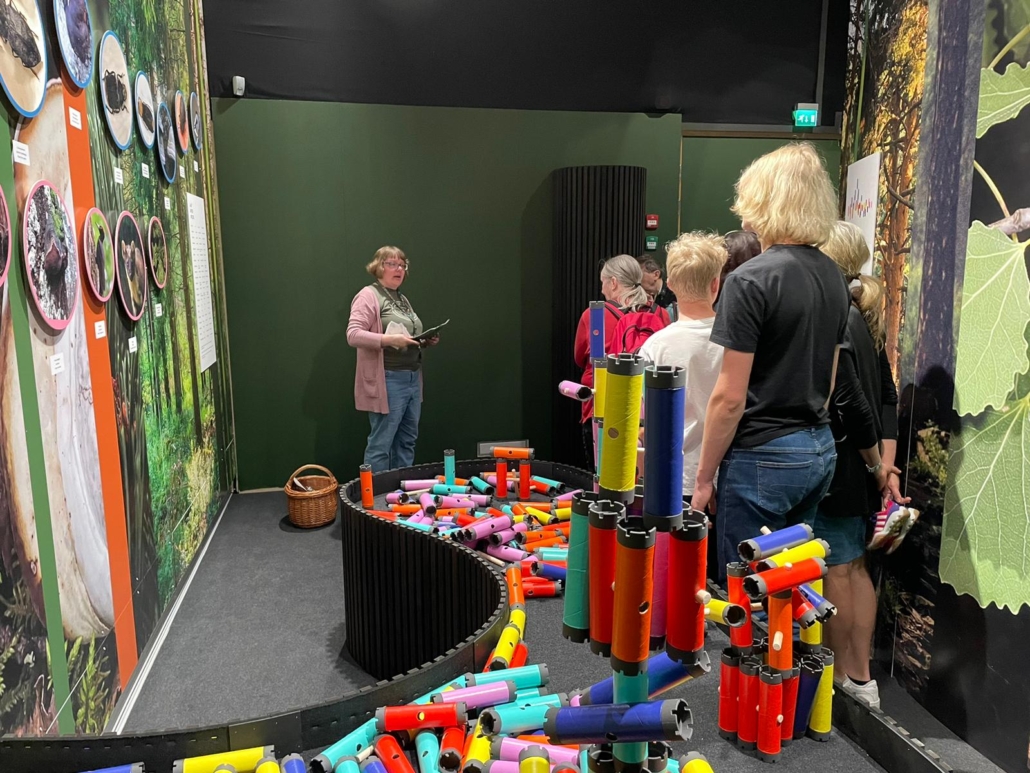
This Burn to be wild exhibition presents information on our own Northern coniferous forests and the use of fire in safeguarding their natural values. The exhibition is part of the Life2Taiga project.
Species and habitats revived by restoration burns
Our forest nature has become monocultural due to logging. Prescribed burning accelerates the restoration of forest biodiversity, returning it to a more natural state. It also promotes the return of species that depend on fire, which is also appreciated by many other species. Species are all dependent on one another. Establishing a fire continuum, i.e. setting a chain of fires close together and frequently enough, is vital to species that depend on fires.
A lack of biodiversity makes forest nature vulnerable to changes, such as climate change, insects and storms. Restoration burns enhance biodiversity, thus enabling forest nature to better respond to changes.
What does a prescribed burning accomplish?
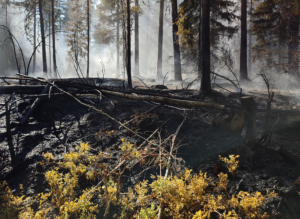
A burn releases nutrients in the soil and provides growing space for deciduous trees, grasses and herbaceous plants. This transforms a forest previously lacking in biodiversity into one filled with a wide variety of species. Hole-nesters, such as woodpeckers, carve out their nesting holes, while creating excellent living conditions for other hole-nesters. The volume of decaying and charred trees is increased, thus making the area an ideal habitat for insects. The insects, in turn, are a source of food for birds and many mammals.
Fire – a good servant when handled properly
Done properly, setting a fire is a safe procedure. However, fire is also something to be feared. In addition to safety, there is also concern for the other inhabitants of the forest when the fires start burning.
The exhibition provides food for thought – what aspects of prescribed burning make you think or please you? Could it be that forests BURN TO BE WILD and diverse again?
Prescribed burning for ecological forest restoration
Life2Taiga is a nature conservation project funded by the European Commission’s LIFE program. The project, which runs from 2022 to 2028, involves collaboration among 17 County Administrative Boards in Sweden, the Swedish Environmental Protection Agency, and Finnish Metsähallitus. The coordination hub for the project is the County Administrative Board of Västmanland, and it is partially financed by the EU’s LIFE program
During the project period, the participating parties will carry out 215 controlled conservation burns covering over 3,400 hectares.
Additionally, on an additional 2,800 hectares, other conservation methods will be employed to achieve outcomes similar to those resulting from natural fires. These forest areas are located within 165 Natura 2000 sites across Sweden and Finland.
Burn to be wild exhibition at Haltia – The Finnish Nature Centre until 6.4.2026 – welcome!
Free, guided tours to burning areas in Nuuksio and exhibition tours
We organize also guided tours, free of charge to the forest restoration places in Nuuksio National Park. We offer also free, guided tours in the Burn to be wild exhibition.
We organize free, guided tours to burning areas in Nuuksio in summer 2026:
Dates will be announced in February 2026.
Starting point: Nuuksio National Park, Högbacka parkinglot, Kattilantie 33, Vihti.
The tour is free of charge. Take proper shoes and something small to eat and drink with you. The rute is approx. 3,5 km.
Guided tours at Burn to be wild exhibition at Haltia 2026
We organize free, guided tours during Haltias’ Outdoor Saturdays at 14.30 and 16.00.
Dates in 2026: 3.1., 7.2., 7.3. and 4.4.
The guided tour is in Finnish and free of charge.
Come and see the Burn to be wild exhibition!
Exhibition tickets and audio guide 13,50/8,50 €
With the Museum Card and under 7 year old, free of charge.
Buy tickets online
Book a guided tour
The project has received funding from the LIFE Programme of the European Union. The material reflects the views by the authors, and the European Commission or the CINEA is not responsible for any use that may be made of the information it contains.
